Cable Tray Designing and Selection
In electrical Systems for laying power cables, cable trays are preferable mode for laying cables over a long distance where digging can’t be feasible or digging cost is very high. Cable tray design and selection involves calculating precise cable weights, evaluating environmental conditions, and matching tray types (like ladder, perforated, or solid bottom) to the cable properties. Proper sizing prevents overheating and leaves necessary space for future system expansions.
Designing and selecting a cable tray system for a fire alarm network requires strict compliance with life-safety codes. Unlike general electrical systems, fire alarm wiring is heavily governed by rules concerning electromagnetic interference (EMI) protection, circuit survivability during a fire, and physical containment.

The primary regulatory standards guiding this design process are NFPA 72 (National Fire Alarm and Signalling Code) and NEC Article 760 (Fire Alarm Systems)
1. Types of Cable Trays
Choosing the right tray largely depends
on the type of installation, cable heat, and environment:
- Ladder Type: The most common (about 75% of
installations), offering excellent airflow, heat dissipation, and easy
cable access for heavy power cables. Ladder cable trays are made of two parallel
side rails connected by rungs to form a ladder-like structure.
- Ventilated/Perforated Trough: Features a solid
bottom with small punched holes, offering moderate airflow while providing
solid continuous support for smaller diameter cables. They are used for lighter
loads and are commonly used in commercial and industrial buildings.
- Solid Bottom: Delivers maximum protection against dust,
water, and falling debris for highly sensitive instrumentation cables,
though airflow is severely restricted.
- Wire Mesh / Basket: Lightweight and
highly flexible; typically favored for data, telecom, and low-voltage
cable routing under raised floors or above drop ceilings.
- Channel: Typically 3 to 6 inches wide; ideal for small instrumentation runs or routing single cables from a main tray down to specific equipment
2. Material Selection
The environment dictates the material
required to prevent corrosion and structural failure:
- Steel (Pre-galvanized or Hot-Dip Galvanized): Most common for
standard commercial and indoor industrial setups due to high strength and
low cost.
- Stainless Steel: Highly resistant to
rust and aggressive chemicals; best for oil and gas or harsh chemical
processing plants.
- Fiberglass (FRP): Non-conductive and highly resistant to corrosive elements, widely used in water treatment plants and heavy chemical facilities.
3. Environmental Cable Selection (Plenum
Spaces)
The choice of cable jacket determines
where you can physically route your tray network:
- Environmental Air Plenums (NEC 300.22): If your cable tray
passes above a dropped ceiling used for building HVAC air return, you must
use Type FPLP (Plenum Rated) fire alarm cables. If you are using
standard Type FPLR (Riser Rated) cables, they must be fully
enclosed in a solid metal tray with tightly fastened covers to contain
smoke in the event of an electrical failure.
- Mechanical Protection (NEC 760.24): Fire alarm cables must be installed in a neat, professional manner. Cables laying loosely or overflowing over the side rails of a tray violate code. Use cable ties listed for use in air handling spaces (plenums) to bundle your cables securely inside the tray structure
4. Sizing & Capacity Planning
Designing a safe and compliant system
requires strictly following fill-rate rules and spacing guidelines:
- Fill Ratio: Power cables should only fill 40% to 50%
of the tray's cross-sectional area to allow adequate heat dissipation. For
data/telecom cables, this ratio drops to 20% to 30%.
- Weight Calculations: Calculate the sum of
cable weights per linear foot and cross-reference with standard NEMA
or IEC load classes to determine required support spans.
- Separation: Power and control/data cables must be
segregated using metal dividers (barriers) or routed in completely
separate trays to prevent electromagnetic interference (EMI).
- Bending Radius: Fittings (bends, tees, crosses) must be selected based on the minimum bending radius of the thickest cable, commonly using a 24-inch radius
5. Support and Installation Standards
- Support Spacing: Trays must be
supported at regular intervals (typically between 1.5 to 3 meters
depending on the load). Supports are usually placed near bends and
fittings to reduce mechanical stress.
- Thermal Expansion: For long runs (especially steel or aluminum in areas with extreme temperature shifts), expansion joints must be installed to accommodate material stretching.
Cable trays are also used where space is low. Also cable trays gives aesthetic looks to electrical systems.
There
are following recommendations for designing cable trays:-
1. Always take 10-20% as Spare capacity.
2. Distances between cables should be from 5 mm to 10 mm.
Now let’s illustrate the same by taking an example:-
Here
we will design cable tray for aluminum cables:-
(i) 10 no’s 2.5 mmsq X 4
Core cables
(ii) 25 mmsq X 4 Core 10 no’s cables
Calculation:
For calculations following Table is used:-
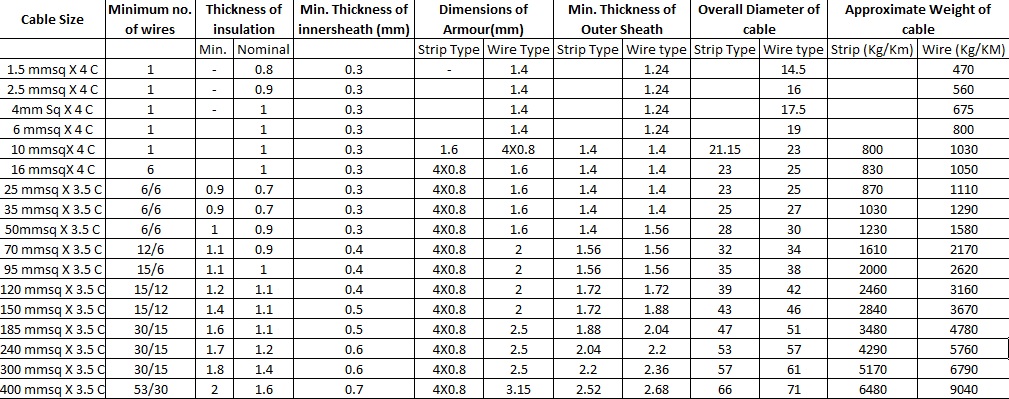
Total Outer Diameter :
Diameter
of 2.5 mmSq.mm Cable =No of Cable X Outer Diameter of Each Cable
=10 X 16 = 160 mm
Similarly
for 25 mmsq cables = 25X10 =250 mm
Total
Diameter of All Cables laying in Tray = (160+250)mm= 410 mm
Now Weight of Cables will be:
Weight
of 2.5 Sq.mm Cables =No of Cable X Weight of Each Cable
=10 X 0.56= 5.6 Kg/Meter
Similarly
for 25 mmsq cable= 10X1.11= 11.1 Kg/ Meter
Total
Weight of All Cables laying in Tray = (5.6+11.1) Kg/Meter= 16.7 Kg/ Meter
Width of all Cables:
Total
Width of all Cables = (Total Cables X min. Distance between Cable) + Cable
Outer Diameter in total
Total
Width of all Cables = (20 X 5) + 410 = 510 mm
Now
after taking 10% Spare Capacity of Cable Tray
Final
Width of all Cables = 1.1X510 =561 mm
Now total area of cables
Total
Area of Cable = width of all Cables X Maximum Height Cable
Total
Area of Cable = 561 X 25 =14025 Sq.mm
Taking
10% Spare Capacity of Cable Tray
Final
Area of all Cables = 1.1X14025 = 15427.5 mmsq.
Now cable tray selected from above calculations is that either we can install 1 no. 600 mm X 50 mm cable tray having weight carrying capacity of 50 kg/ meter, this cable tray has overall area of 30000 mmsq , Or we can install 300 mm X 50 mmsq 2 no. s cable trays with area = 30000 mmsq.
We can even use single 300 mmsq X 50 mmsq cable tray and placing one cable over another.
Usually perforated cable trays are used in electrical systems.
Whether you deploy Circuit
Integrity (CI) cables or an enclosure wrap,
standard mechanical structural constraints apply under fire conditions:
·
No Aluminum Hardware: Aluminum
melts at roughly 660°C (1,220°F), which occurs within the first 10 minutes of a
standard ASTM E119 fire curve. All cable trays, splice plates, and hardware
fittings must be constructed from heavy-duty Steel or Stainless Steel.
· Concrete Anchor Ratings: Trays must be anchored to the ceiling structure using concrete fasteners that carry an explicit fire-resistive structural rating. Standard drop-in anchors can slip or fail as concrete cracks and shears under high heat loads.
Cable Tray Wiring Systems Have Many Cost
Advantages
Cost is usually a major consideration in the selection of a wiring system. This article provides information as to where cable tray wiring system cost savings will occur; however, it is not the intent of this article to state that the selection of a wiring system should be based only on cost.
Early in the life of a project, the costs and the features of the applicable wiring methods should be evaluated to provide decision information for the selection of the best possible wiring method or methods for the project. The evaluations should include items that relate to cost, dependability, future changes, maintenance, safety, and space savings. Usually the evaluation will determine if a cable tray wiring system or a conduit wiring system is to be selected as the projects major wiring system. Both large scale and small cable tray wiring systems have been in use for the last 45 years in North America and longer in other parts of the world. Forty-five years of operating experience has proven that cable tray wiring systems are superior to conduit system wiring systems for power, control signal and instrumentation circuits.
The following functions must be properly executed to obtain a quality
wiring system installation:
1. Select the
most desirable wiring method.
2. Properly
design the wiring systems.
3. Specify
quality materials.
4. Plan and
execute the installation’s sequence of activities and the techniques to be
used.
5. Control of the
quality of the installation.
Depending on the type of circuits and the wiring density, an installed cable tray wiring system may result in a total cost reduction (material + labor) of up to 60 percent compared to the cost of an equivalent conduit wiring system. There is also the potential for cost savings to occur in the design, material procurement, installation and maintenance areas when the wiring system is a cable tray wiring system.
Potential Design Cost Savings:
1. Very few
projects are completely defined at the start of design. As a project progresses
through the design phase, the operating logic and safety requirements are
developed and refined. The changes and additions required to meet the projects
needs occur all through the design cycle and at times even into the initial
construction phase. For projects that are not 100 percent defined before the
start of design, the cost of and time used to cope with changes during
the engineering and drafting design phases will be substantially less for a
cable tray wiring system than for an equivalent conduit system.
It only takes a few minutes of design time to change the width of a cable tray
to gain significant additional cable fill capacity. For an additional cost of
less than 10 percent of the basic cable tray cost, 6 inches of additional cable
tray width can be obtained. This extra 6 inches will accommodate large numbers
of small diameter analog and/or digital signal cables. Where banks of conduits
are involved, any change in wiring capacity requirements during the late stages
of engineering and drafting design are very costly and time consuming.
Significant conduit system additions or revisions are usually required to
provide exit and/or entry points in the conduit runs for the circuit additions
made late in the design phase.
Cable tray’s unique feature that allows a cable to enter or exit a cable
tray anywhere along the cable tray’s route provides for the easy accommodation
of cable additions. No raceway wiring system has this unique feature.
2. Using cable
tray wiring systems simplifies the overall wiring system design process
as fewer details are required for properly designed cable tray runs than for
properly designed conduit banks. Conduit system design can be very complex due
to the need for pull boxes, splice boxes and the involved conduit bank
supports.
3. The fact that
a cable tray system isn’t required to be mechanically continuous eliminates
the need for many complex installation details for conductor/cable entries into
equipment and in dealing with cable tray run interferences.
4. The installation
space requirement is smaller for a cable tray than an equivalent
capacity conduit system. For cable tray systems, there is less apt to be space
conflicts with other engineering disciplines on a project than for a conduit
system. Coordination design time is saved by dedicated fixed dimensioned installation
zones for the cable tray system. The cable tray installation zone’s size will
not grow as changes are made as it does for conduit banks in large projects.
5. Wire management systems for cable tray wiring systems consume less design time than is required for a conduit system. A spread sheet based wire management program may be used to control the cable tray fill. While such a system may also be used for controlling conduit fill, large numbers of individual conduits will require fill monitoring while only a few cable tray runs require fill monitoring for an equivalent capacity wiring system.
Potential Material Procurement Costs Savings:
1. There
are fewer different components in a cable tray wiring system than
in a conduit wiring system. Fewer different components means savings due to
fewer components to specify, order, receive, store and distribute.
2. Excluding
conductors, the cost of the cable trays, supports and miscellaneous
items may provide a material savings of up to 80 percent as compared
to the cost of conduits, supports, junction boxes, pull boxes and miscellaneous
materials. The NEC fill capacity for an 18-inch wide ladder or ventilated
trough cable tray is 21 square inches. It takes seven – 3 inch conduits to
match that fill capacity.
3. For feeders or branch circuits, where the installations involve parallel phase conductors, there is a copper cost savings for cable tray wiring systems. The derating factors don’t apply to three conductor or single conductor cables in cable tray as they do for conduits. For the same circuit capacity of paralleled phase conductors, the cable tray installation uses fewer pounds of copper than the conduit installation. Where phase conductors are not paralleled, the cost of the 600 volt multiconductor cables used in cable trays is greater than the cost of the single conductor cables used in conduit. This cost difference depends on the insulation systems, jacket materials and cable construction.
Potential Installation Cost Savings:
1. The
installation of a cable tray wiring system requires fewer man-hours than
an equivalent conduit wiring system. This is where the major cost
savings are obtained for the cable tray wiring system. Smaller sized
electrician crews may be used to install a cable tray wiring system as compared
to an equivalent conduit wiring system. This allows for manpower leveling, the
peak and the average crew size would be almost the same number. The electrician
experience level required for cable tray can be lower than that for a conduit
wiring system as fewer electrician with conduit bending skills are required.
2. Cable trays
can be installed faster than conduit banks. Since the work is completed
in a shorter time period there is less work space conflict with the other
construction disciplines. This is especially true if the installations are
elevated and significant amounts of piping are being installed on a project.
3. Many more
individual components are required in a conduit system than in a cable tray
system. This results in the handling and the installing of large amounts of
individual conduit items vs. small amounts of individual cable tray items. At
elevated installation levels, many additional man-hours will be required to
transport the components needed for the conduit system up to the installation
level.
4. Conduit
systems contain materials and installation practices that are more complex and
costly to install than those used in cable tray systems. This is
the reason that cable tray installation labor costs are significantly below
conduit system installation labor costs.Conduit systems require pull or splice
boxes where there is the equivalent of more than 360 degrees of bends in a run.
Cable tray systems don’t require pull or splice boxes. Conduit systems
normally require more supports and the supports are more complex. When
penetrating walls, conduits banks require larger holes and more repair work
than is required for cable trays.Concentric conduit bends for direction
changes in conduit banks are very labor intensive and costly. However if
they are not used, the installation will not be very attractive. The time
required to make a concentric bend is increased by a factor of three to six
over that of a single shot conduit bend. This labor intensive practice is
eliminated when cable tray wiring system are used.
5. Conductor pulling is more complicated and labor intensive for conduit wiring systems than for cable tray wiring systems. For conduit systems, it is necessary to pull from equipment enclosure to equipment enclosure. The conduit system is required to be mechanically continuous from equipment enclosure to equipment enclosure. Tray cables being installed in cable trays don’t have to be pulled through or into the equipment enclosures. Tray cable may be pulled from near the initial enclosure along cable tray route to near the termination enclosure, then the tray cable is inserted into the equipment enclosures for termination. Making the conduit system wire pulls through the enclosures increased the possibility of conductor insulation damage.
Potential Maintenance Cost Savings:
1. An article in
the October 1991 EC&M magazine, “Cable Pulling for Conduit Wiring Systems,”
stated that 92 percent of the insulated conductors that fail do so due to the
fact that they were damaged during installation. The failures of the insulated
conductors may create unnecessary safety conditions and significant cost
problems. Why not select a wiring method where during the past 45 years
its conductor failures due to installation damage have been almost
non-existent? Cable tray with quality cables is that wiring method.Conductor
insulation failures in cable tray wiring systems are rare. The reason for
this that the tray cables are rarely damaged during the installation. Many of
the conduit conductors that fail do so due to the fact that they have been
damaged when they were pulled into the conduits. Excessive forces imposed on
the conductor’s insulation system during the conductor installation process can
be very destructive. For some critical combinations of conductors and sizes of
conduit, jamming of the conductors in the conduit can occur during the
conductor installation. This may result in conductor insulation damage.
Critical jam ratio (J.R. = Conduit ID/Conductor OD) values range from2.8 to
3.2. The 1996 NEC Chapter 9 Table 1. Fine Print Note is an alert for this
serious problem.
2. If circuit
additions are made in the future, the fact that the cables can enter or exit the
cable tray anywhere along its route allows for the cable additions at the
lowest possible future cost. This is a feature that is unique to cable
tray. Future cable fill space capacity to accommodate cable additions to a
cable tray can be provided at a very low cost.
3. The cable tray
wiring systems reduce the potential for moisture related equipment
failures. Tray cables don’t provide the internal moisture paths that
conduits do. This lowers future maintenance costs. Moisture is a major cause of
electrical equipment and material failures. The day to night temperature
cycling results in moisture laden air being drawn into the conduits and the
moisture in the air condensing. The condensed moisture accumulates in
conduits systems. The conduits pipe the accumulated moisture into the
electrical equipment enclosures. Over time, this moisture may accelerate the
corrosion of some of the equipment’s metallic components and deteriorate the
equipment’s insulation systems to failure. Conduit seals are not effective in
blocking the movement of moisture. Conduit systems have to be specifically
designed to reduce moisture problems and this is rarely done.
4. A properly designed and installed wiring system will not be a fire ignition source. It is possible that the wiring system may be exposed to an external fire. For a localized fire, the damage to a cable tray wiring system will be less to a cable tray system than to the conduit system. This has been the case in some industrial facility fires. The damage to PVC jacketed tray cables and the cable tray is most often limited to the area of flame contact area plus a few feet on either side of the flame contact area. When such a fire envelopes a steel conduit bank, the steel conduit is a heat sink and the insulation of the conduit’s conductors will be damaged for a considerable distance. Thermoplastic insulation may fuse to the steel conduit and the conduit will need to be replaced for many feet. This occurred in an Ohio chemical plant. The rigid conduit had to be replaced for 90 feet. Under such conditions, the repair cost for fire damage would normally be greater for a conduit wiring system than for a cable tray wiring system. In the Ohio chemical plant fire, large banks of conduit and multiple runs of cable tray were involved. The cable tray wiring systems were repaired in two round-the-clock days, and the conduit wiring systems were repaired in six round-the-clock days. The conduit system repair required more than three times the manhours that was used for the cable tray system. In the July 1995 EC&M magazine, “Protecting Life Safety Circuits In High Rise Buildings” the section titled “Protecting signal and communication wiring” states the following: “Results of Steiner Tunnel testing performed by various cable manufacturers actually indicates that conduits tend to act as heat sinks, thereby decreasing the time required to damage insulation to cause conductor failures.” This is a big negative for conduit systems. Cable tray wiring systems have significant cost savings advantages over conduit wiring systems. They also have convenience, dependability and safety advantages over conduit wiring systems.
NEMA vs IEC load classes for Cable Tray
Designing and Selection
The fundamental difference between NEMA and IEC for cable tray design is that NEMA uses a rigid matrix of pre-defined structural classes, whereas IEC requires the designer to select a tray based on a custom manufacturer-declared Safe Working Load (SWL).
When designing a project, mixing these two methodologies can cause structural failures or massive cost overruns. Here is how to apply and choose between these structural standards during your engineering phase.
1. Structural Sizing Logic (How to Choose Your Design
Flow)
The NEMA Workflow (Pre-Calculated Classes)
1. Find Total
Load: Calculate the exact weight of your cables per foot (e.g., 65 lbs/ft).
2. Set Support
Span: Choose structural support locations based on civil constraints (e.g.,
every 12 feet).
3. Select Class: Find the NEMA
class that meets or exceeds both requirements.
o Example: 12 feet span + 65 lbs/ft load points directly to NEMA Class 12B (which handles 75 lbs/ft at 12 feet).
The IEC Workflow (Custom Performance Matching)
1. Find Total
Load: Calculate cable mass in kilograms and convert to Newtons per meter (1
kg/m ≈ 9.81 N/m).
2. Apply
Safety/Environmental Multipliers: Add wind, ice, or human maintenance safety factors
directly to your load profile.
3. Query Manufacturer Datasheet: Match your exact span (e.g., 2.0 meters) and total required load (e.g., 800 N/m) against the manufacturer's certified IEC 61537 SWL curve graph
2. Selection Criteria: When to Use Which Standard?
Choose NEMA if:
·
Your project is physically located in North America or
utilizes NEC (National Electrical Code) Article 392 sizing algorithms.
·
Structural steel supports are pre-fabricated at large,
fixed intervals (e.g., 12, 16, or 20 feet pipe racks).
·
You want rapid, off-the-shelf procurement where
interchangeable parts from different manufacturers must fit together reliably.
Choose IEC if:
·
Your project is being built in Europe, the Middle
East, or Asia, or references IEC 60364 installation rules.
·
You are trying to optimize and reduce material costs.
IEC allows you to use a lighter, cheaper tray if your actual cable weight is
low, rather than forcing you into a heavy "Class A" bracket.
· The installation environment features high physical vibrations or sudden temperature drops, requiring the strict IEC cold-impact structural testing protocols.
Cable Tray Designing and Selection as per
NFPA 72
NFPA 72 Section 12.4 establishes four distinct levels of pathway survivability. Your cable tray type, material, and cover options must adapt based on the specific system requirement.
Level 0 (No Fire Resistance Required): Pathways with
no specific fire-rated protection. Standard wire-mesh or open ladder trays
are acceptable for indoor, general-floor building applications.
Level 1 (Sprinkler Protected): Pathways
passing through areas protected entirely by an automatic sprinkler system.
·
Tray Requirement: Trays require solid-bottom
configurations or GI Perforated Cable Trays equipped with tightly fastened top
covers to shield fire alarm wires from water drop impact and mechanical
damage.
Level 2 (2-Hour Fire Rated): Pathways that
must remain fully operational for 2 hours during an active building fire (e.g.,
partial evacuation voice systems, EVACS).
·
Tray Requirement: You must utilize UL 2196
Certified Circuit Integrity (CI) Cables laid in the tray, or an approved
structural enclosure wrapping system. The cable tray itself does not provide
fire rating; the cable listing governs the installation.
Level 3 (2-Hour Rated + Sprinklers): The highest layer of protection, requiring a 2-hour fire-rated mechanism operating in a fully sprinklered zone. Combines both Level 1 and Level 2 tray infrastructure rules (covers, water shielding, and CI-rated cables).
NFPA 72 defines how pathways recover from faults. If you are routing redundant lines through cable trays, your engineering layout must comply with physical separation guidelines.
Class A & Class X Separation
Class A and Class X pathways feature a loop architecture designed to
maintain operation even with a single open circuit breaker or field break.
·
The Rule: The outgoing loop and the return loop
are strictly prohibited from being installed in close proximity or sharing the
same cable tray.
·
Design Standard: Annex material suggests a
minimum physical separation of 12 inches (300 mm) vertically or 48
inches (1.22 m) horizontally. They must travel in entirely independent
cable tray paths across the facility to ensure a localized incident cannot
sever both loops simultaneously.
Class B Layouts
Class B pathways do not include a return loop and terminate at an
end-of-line resistor. These can be grouped together within a single local tray
run, provided they are structurally isolated from other high-voltage
components.
Unlike power cables that radiate significant heat, low-voltage Signaling
Line Circuits (SLC) and Notification Appliance Circuits (NAC) run relatively
cool. However, tight mechanical grouping causes data packet corruption and
crosstalk.
·
Design Limit: Do not exceed a 40% cross-sectional area fill
ratio for any fire alarm cable tray. Leave a minimum 60% open air gap
inside the tray to ease future maintenance and system field upgrades.
Flange and Depth Selection
·
Minimum Depth: Specify a minimum internal
usable tray depth of 2 inches (50 mm) to 3 inches (75 mm) to safely retain
light, bundled fire alarm wires.
· Material Spec: High-quality installations prioritize steel trays powder-coated in Signal Red (RAL 3001) to clearly flag the life-safety containment network to other trades, preventing accidental damage or unauthorized cable modifications
Fire alarm loop cables operate over low-frequency digital protocols.
Electromagnetic Interference (EMI) generated from nearby power systems can
easily introduce false alarms or trigger unexpected panel ground faults.
·
The Barrier Rule: If a multi-compartment tray is
utilized to route adjacent security or auxiliary low-voltage signals, a
continuous, grounded metallic internal divider wall must separate the
fire alarm wires.
· Bonding: Every section of the metallic cable tray system must be electrically bonded to the next using factory grounding straps, creating a continuous low-resistance path to the building ground matrix to bleed away inductive noise.
When an engineering design mandates an NFPA 72 Level 2 or Level 3
Pathway Survivability classification, the system must maintain fully
operational fire alarm communications for a continuous 2-hour period
directly inside a building fire zone.
To achieve this, designers must choose between two distinct pathways: installing UL 2196 Certified Circuit Integrity (CI) Cables inside a standard cable tray or encapsulating a standard tray run using an Approved Structural Enclosure Wrapping System.
Approved Structural Enclosure Wrapping
Systems
UL
2196 is the standard for test performance of resistive cables under active
flame exposure reaching up to 1,010°C (1,850°F) while under full electrical
load. Instead of sourcing highly specialized CI cables, you can use standard,
lower-cost Type FPLP or FPLR fire alarm wires by completely wrapping the
outside of the cable tray structure in a certified fire blanket envelope.
Approved System Types
·
Endothermic Blankets: Multi-layer,
chemically active protective blankets (such as 3M Interam or Unifrax FyreWrap)
that absorb heat energy. Under intense external flame, they release chemically
bound water molecules to actively cool the interior space of the tray.
· Rigid Fire Boards: Prefabricated silicate or calcium-board box structures built directly around the cable tray routing lines.
Structural Design Considerations:
·
Massive Structural Weight Penalties: Fire blankets
are extremely dense and heavy. Wrapping a tray adds an immense static
structural load to your building hangers. You must calculate the weight of the
tray, the cables, and the wrapping material, then size your support rods
(typically upgrading to minimum 1/2-inch or 5/8-inch threaded rods)
accordingly.
· Derating the Cable Tray Fill: Wrapping turns the cable tray into an unventilated, completely sealed envelope. Because heat cannot escape, the available cable filling space drops dramatically. Designers must derate the continuous current-carrying conductors inside to prevent thermal buildup during normal operation.
Mechanical Installation Constraints:
·
The Listing Controls the Design: You cannot
lay CI cables in a tray haphazardly. You must follow the cable manufacturer’s
specific UL FHIT (Fire Resistive Cable Systems) data profile. If you
deviate from the FHIT instruction packet, the 2-hour rating is voided.
·
Single-Layer Layout Restriction: Most UL 2196
listings explicitly prohibit grouping or bundling CI cables into deep,
multi-layer piles. Cables must typically be laid side-by-side in a strict single
layer along the tray floor to prevent heat retention from degrading the
glass-matrix or ceramic insulation during a fire.
· Support and Anchor Spacing: Standard steel cable trays used for CI routes require a significantly higher mechanical support frequency. While normal low-voltage trays can handle 3-meter (10 ft) spans, a UL 2196 tray layout often dictates structural hardware attachment points every 1.2 to 1.5 meters (4 to 5 feet) to prevent the tray steel from bending or sagging under extreme fire temperatures.
Indian standard or code
In India, cable tray designing, selection, and structural installation are governed by a combination of the National Electrical Code (NEC) of India, standard specifications from the Bureau of Indian Standards (BIS), and statutory guidelines from the Central Electricity Authority (CEA). No specific details based on Fire Detection & alarm system cables. Its under Electrical cable.
BIS Structural Material & Galvanization Standards
When procuring or designing a cable tray system under Indian public
sector tenders (like GeM - Government e-Marketplace), components must
explicitly satisfy these structural metal benchmarks:
·
Structural Base Steel: Trays are
typically fabricated using Hot Rolled (HR) steel complying with IS 2062
(Steel for general structural purposes) or Cold Rolled (CR) steel complying
with IS 513.
·
Hot-Dip Galvanization: To ensure
outdoor atmospheric endurance, structural pieces must be galvanized per IS
2629 and IS 4759.
o
Thickness Metric: The coating uniformity and mass
of the zinc deposit must satisfy IS 2633 and IS 6745 (typically
demanding a minimum baseline thickness of 65 to 70 microns for
industrial locations).
· Standard Tray Dimensions: Per IS 14927, standard commercial piece lengths are set at 2.5 meters. Standard width sizing scales horizontally along fixed steps: 150 mm, 300 mm, 450 mm, and 600 mm, featuring side-rail depths of 50 mm, 75 mm, or 100 mm.
Indian Sizing, Loading, and Fill Layout Rules
Sizing and Fill Ratios (NEC of India)
·
Power Cables: Multi-core power distribution loops running across
open-ladder profiles must not exceed a maximum cross-sectional filling capacity
of 40% to 50%.
· Control / Instrumentation Cables: Ventilated perforated troughs routing control signals can scale up to a 50% fill factor.
Structural Loading and Deflection Limits
India broadly maps its performance targets directly to the international
IEC 61537 standard rather than the American NEMA alphanumeric matrix.
·
Deflection Cap: Under full structural load
capacity (e.g., standard 600 mm wide trays are engineered to safely support a
working baseline mass of 100 kg per linear meter), the total longitudinal
structural deflection down between vertical columns must never exceed L/100
(1% of the distance between supports).
· Support Spacing: Support structures (typically fabricated from MS angles or C-channels conforming to IS 808) must be anchored at a maximum structural distance of 1.5 meters to 2.0 meters depending on total load metrics.
Separation & Earthing Mandates (CEA / IS 1255)
·
The Voltage Separation Rule: High Voltage
(HT) cables and Low Voltage (LT) loops should ideally run along entirely
distinct vertical tiers or independent structural runs. If sharing a wide tray
structure, they must be partitioned using an IS 2062 steel divider plate.
· Continuous Earthing: Per CEA Regulation 106, all metallic structures must maintain absolute electrical continuity. The entire tray network must be bonded at every single junction splice plate using a copper or GI earth wire/strip. This continuous grounding loop must tie back to the main station earth mat to safely dissipate prospective fault currents
FAQs
1. What is a
cable tray?
A cable tray is a metal or non-metal structure used to lay electrical cables and wires, serving to support, protect, and guide the cables.
2. What is the
role of a cable tray in electrical engineering?
A cable tray allows for the neat and aesthetic arrangement of cables, improves the reliability and safety of the lines, and facilitates maintenance and repair.
3. What are the Key
Indian Standards (BIS)?
While installation
and trunking have dedicated codes, cable tray manufacturing and support
structure calculations are usually referenced in broader electrical and
material codes:
·
IS
1255:1983: Code of Practice
for the installation and maintenance of power cables (up to 33 kV).
Covers routing clearances, laying methods, and thermal considerations.
·
IS
14927-1:2001: Cable
Trunking and Ducting Systems (General Requirements). Applicable when
dealing with closed, non-metallic, or metallic raceways.
·
IS 2629
& IS 2629-1985:
Recommended practice for Hot-Dip Galvanizing of iron and steel, which
defines the corrosion protection criteria for metallic cable trays.
·
IS 1367: Specifies the required zinc coating on
threaded portions of bolts, nuts, and washers.
· IS 2062 & IS 513: Standard for structural steel (HRCA) and carbon steel (CRCA) sheets used in tray fabrication
4. What is the
difference between a cable tray and a cable ladder?
A cable tray is a broader concept, referring to any support structure for laying electrical lines, whereas a cable ladder is specifically designed for laying cables.
5. What are the
main materials used for cable trays?
Common materials include steel, aluminium alloy, stainless steel, and fiberglass.
6. What
environments are aluminum alloy cable trays suitable for?
Aluminum alloy trays are lightweight, corrosion-resistant, and suitable for areas where weight reduction is important, such as high-rise buildings and large factories.
7. What are the
characteristics of stainless steel cable trays?
Stainless steel trays are highly corrosion-resistant, aesthetically pleasing, and durable, suitable for high-corrosion environments like chemical and marine industries.
8. What
environments are fiberglass cable trays suitable for?
Fiberglass trays have excellent corrosion resistance and insulation properties, suitable for corrosive, damp, and electrically isolated environments.
9. What factors
should be considered when selecting a cable tray?
Factors include the number, diameter, and weight of cables, the tray’s load capacity, installation space, environmental factors (e.g., corrosion, temperature, humidity), and budget.
10. How do you
determine the specifications and size of a cable tray?
Determine the specifications and size based on the outer diameter, number, and arrangement of the cables, as well as the tray’s load-bearing capacity.
11. How is the
load capacity of a cable tray calculated?
It is calculated based on the weight and number of cables, as well as the structure and material of the tray.
12. How do you
ensure the cable tray’s load capacity meets the requirements?
Choose a cable tray of appropriate specifications and structure, strengthen supports and fixings, and ensure secure installation.
13. What risks
arise if the cable tray’s load capacity is too low?
It may lead to deformation, fracture of the tray, affecting the safe operation of the cables and potentially causing safety accidents.
14. How can you
increase the load capacity of a cable tray?
The load capacity can be increased by increasing the tray’s wall thickness, optimizing the structural design, and adding support points.
15. Why do cable
trays need fire protection treatment?
As the supporting structure for electrical cables, cable trays need to have certain fire resistance to protect the cables from damage or to slow the spread of fire in case of a fire.
16. How can the
fire resistance of a cable tray be improved?
Fire resistance can be improved by applying fire-retardant coatings, installing fire barriers, or using fire-resistant materials.
17. What are the
common corrosion protection methods for cable trays?
Common methods include hot-dip galvanizing, thermal spray zinc coating, and spraying anti-corrosion coatings.
18. How can
cable crossings and entanglement be avoided when wiring in cable trays?
Rationally plan the direction and laying sequence of the cables, use layering, zoning, and segmentation wiring methods. Fix cables with ties or clips to prevent looseness and entanglement.
19. How do you
consider cable slack length when wiring in cable trays?
Allow appropriate slack to accommodate cable expansion and contraction due to temperature changes, and to facilitate maintenance or replacement.
20. How do you
choose the appropriate cable supports when wiring in cable trays?
Select supports based on the number, weight, and diameter of the cables. Pay attention to the spacing and installation method of the supports to ensure even distribution and secure fixing of the cables.
21. How can
grounding and shielding of cables be ensured when wiring in cable trays?
When wiring, ensure proper grounding and shielding of cables to reduce electromagnetic interference and electrostatic accumulation. Use dedicated grounding clamps or grounding wires to connect the cable grounding end to the tray or the grounding system.
22. How should
cable trays be maintained and serviced during use?
Regularly inspect the tray’s appearance, deformation, fixing methods, and the condition of the cable installation. Clean dust and debris from the tray, and replace or repair damaged trays and cables in a timely manner.
23. How do you
perform regular inspections and assessments of cable trays?
Conduct regular inspections of the tray’s appearance, deformation, fixings, and the cables. Evaluate whether the tray’s load-bearing capacity, fire protection, and corrosion resistance meet the requirements. Record and address any issues found.
24. What safety
issues should be considered when repairing or replacing cable trays?
Ensure the power is turned off and warning signs are placed. Use the proper tools and methods to avoid damaging cables and trays. Pay attention to worker safety to prevent accidents such as falls or electrical shocks.
25. How is the
cable tray installation checked after maintenance or replacement?
The inspection should cover the tray’s installation quality, fixing methods, deformation, and cable layout, ensuring the work meets the relevant standards and design requirements.
26. How is the
cable tray installation checked after maintenance or replacement?
The inspection should cover the tray’s installation quality, fixing methods, deformation, and cable layout, ensuring the work meets the relevant standards and design requirements.
27. What are the
special requirements for cable trays in vibration-prone environments?
In vibration-prone environments, trays must have good anti-vibration performance. Reinforced trays or additional support points may be required to enhance stability. Use anti-vibration connectors to ensure the trays do not detach or get damaged.
28. What
protective measures are needed for cable trays in outdoor environments?
Outdoor cable trays need protective measures against wind, rain, sunlight, and corrosion. Use corrosion-resistant materials like stainless steel or fiberglass, apply anti-corrosion coatings, and install waterproof caps or covers to prevent rainwater from entering the trays.
29. What
considerations should be made when using cable trays in clean rooms?
In clean rooms, cable trays need to be kept clean to avoid contamination of the environment. Use easy-to-clean materials like stainless steel or aluminum alloy, and avoid generating dust or pollutants during installation. Regularly clean and maintain the trays to ensure they remain free of dust.
30. How should
the span and layer spacing of a cable tray be determined?
The span and layer spacing should be based on the weight, number, and installation method of the cables. Generally, the span should not be too large to avoid tray deformation, and the layer spacing should be large enough for cable cooling and maintenance.
31. Case Study:
Cable Tray Selection and Installation in a High-Rise Building
For a high-rise building, the tray’s selection and installation were based on the weight limitation and aesthetic considerations. Aluminum alloy trays were selected for their lightweight and corrosion resistance. The installation process used prefabricated components and modular installation to improve construction efficiency and quality.
32. Case Study:
Cable Tray Design and Installation in a Factory
For a factory, the cable tray design and installation were based on production requirements and cable laying needs. Large-width tray-style trays were selected to accommodate numerous cables. The design considered the tray’s load-bearing capacity, structure, and fixing methods. During installation, coordination with other equipment was prioritized to ensure the tray’s stability and reliability.
33. Case Study:
Cable Tray Selection and Installation in a Subway Station
For a subway station, the cable tray selection and installation focused on fire resistance and durability. Stainless steel trays were chosen for their corrosion resistance and longevity. The installation paid attention to coordination with civil engineering to ensure tray positioning and height met design specifications.
34. Case Study:
Cable Tray Design and Installation in a Data Center
In a data center, the cable tray design and installation addressed high standards for cable management. The trays selected were of high performance, such as tray-type or trough-type. Design considerations included load-bearing capacity, structural form, and fire protection. The installation process emphasized integration with equipment in the server room to ensure stability and aesthetics.
35. Case Study:
Cable Tray Selection and Installation in a Petrochemical Plant
For a petrochemical plant, the cable tray selection and installation took into account requirements for corrosion resistance and explosion protection. Stainless steel or fiberglass trays were selected for their high corrosion resistance. The installation also considered explosion-proof requirements to ensure safe and reliable tray use.
36. We have a
customer who would like to install the majority of cable tray in his new
industrial facility in what I call an “Edge-Wise” orientation. That is, each
cable tray rung would point in a vertical direction as opposed to the usual
horizontal direction.
The local
electrical inspector has stated that he has no issues with this as long as the
manufacturer’s specifications have guidelines in how to install it this way. I
have searched and can find no indication in any vendor’s literature that
acknowledges the possibility that cable tray would ever be installed in this
orientation.
There is no NEC or other limitation on cable trays that would prevent the “Edge-Wise” orientation. The CTI needs to develop guidelines for this installation. This type of installation minimizes dust accumulation in dust locations and could be advantageous in other situations.
37. It appears
that the NEC doesn’t address the maximum allowable fill area for a solid
bottom, channel cable tray. It does however, address ventilated channel cable
tray (Article 392.9(E)What is your opinion regarding the maximum fill area for
solid bottom channel, given that multiconductor or signal cables only are
installed?
The CTI has submitted a proposal to amend the 2002NEC to provide this information.
38. Does
the NEC apply to telecommunication cabling installations?
Yes, in the following articles: 645 Information Technology Equipment 725 Class 1, Class 2, and Class 3, Remote-Control, Signaling, and Power-Limited Circuits 770 Optical Fiber Cables and Raceways 800 Communication Circuits 810 Radio and Television Equipment 820 Community Antenna Television and Radio Distribution Systems The sections of these articles that may apply depend on the installation; location; cable selection and equipment. There are other NFPA standards that may apply which include: NFPA 75 Protection of Electronic Computer/Data Processing Equipment NFPA 780 Installation of Lightning Protection Systems
39. Is it
necessary to provide tie-down cables installed in a cable tray?
Yes; cables are
tied down in cable trays to keep the cables in the cable tray, to maintain
spacing between cables, or to segregate or confine certain types of cables to
specific locations. The last two items can also be accomplished with a solid
fixed barrier. The NEC in section 392.8(B)indicates that in other than
horizontal runs, cables shall be securely fastened to transverse members of the
cable trays.
For vertical
installations, the cables may hang away from the cable tray if not tied down.
Although this section of the NEC does not require cable tie down in horizontal,
it may be necessary to meet other requirements. For instance, it may be
necessary and appropriate to space power cables at least a diameter apart to
approximate the free air amperage rating of a cable. In hazardous dust
locations (class II, division 2), it is required to space type MC and TC cables
at least the larger cable diameter apart and arrange the cables in a single
layer.
Multiconductor
power cables, 4/0 and larger, rated 2,000 volts or less, are required to be
installed in a single layer by the NEC [Section392.9(A)(3)Tying down these
cables is one way to insure this requirement.
Where single
conductor cables are installed it is highly desirable to tie the cables down to
keep them in the tray.
There are other situations where tying down the cables is important. The selection of the type of cable tie is also very important. For further information, see CTI Technical Bulletin No. 5, Tie Down Practices for Multiconductor Cables in Cable Trays.
40. Are Cable
Trays listed?
Metallic cable trays are not required to be listed because they are a support system. Metal cable trays can be U.L. classified with regard to suitability for use as an Equipment Grounding Conductor. Compliance with other appropriate NEC cable articles is required. CTI recommends compliance with National Electrical Manufacturers, NEMA, Standards Publications Nos. VE1 and VE2, and the manufacturer’s recommendations.
41. Are
there cable fill requirements for cable trays?
Yes — NEC Sections 392.9, .10, .11 and .12, and Tables 392.9, 392.9(F)) and392.10(A), describe the fill in terms of area and cable diameters. The key issue is ampacity. The ampacity criteria in article 392 is based on not exceeding these fill values. The number and type of conductors that can be installed in a cable tray is also limited by the weight of the cables and other load factors for the cable tray for a given load rated cable tray. See NEMA VE-1 and manufacturer’s data. Size the width of cable tray and the load rating for expansion and additions. Adding six inches to the width of a tray increases its price by approximately 10%.
42. What materials
/ finishes are available for the various cable tray systems
1.
Steel (Min. Yield = 33KSI) (35 KSI for
Stainless)
·
Plain: hot rolled pickled and oiled steel per
ASTM A569 (Commercial Quality) or A570 (Structural Quality)
·
Pre-Galvanized: mill galvanized steel per ASTM A653 CS
(Commercial) or SS (Structural) G90
·
Hot Dip
Galvanized After Fabrication: plain
steel which is hot dipped after fabrication per ASTM A123.
·
Stainless
Steel: type 304 or 316L
fully annealed stainless steel
2.
Aluminum (Min.Yield = 23 KSI)
·
6063-T6 or
5052-H32 alloy per ASTM B209
3.
Fiber
Reinforced Plastic (FRP)
·
Polyester
and Vinyl Ester resin systems available
·
meet ASTM
E-84 smoke density rating; Polyester 680, Vinyl Ester 1025
· Class 1 Flame Rating and self-extinguishing requirements of ASTM D-635.
43. Can
mechanical utility piping or tubing containing water or compressed air be
installed in cable trays with electrical cables?
No. Cable trays are a support system for electrical cables, power, signal, and communication and optical fiber cables. NEC section 300.8 does not permit any tube, pipe, or equal for water, air gas, drainage, steam, or any service other than electrical in raceways or cable trays containing electrical conductors.
44. I am in the
process of establishing guidelines for raised floors in communications
facilities and plan to mandate that all cabling under raised floors be
installed on an appropriate type cable tray. Are you aware of any industry
standard that may mandate the use of cable trays under raised floors,
particularly, power and signal cables?
We are not aware of such industry standard, but cable trays offer significant advantages for this type of installation and in other computer, telecommunications, and power installations. The telecommunications industry is a very strong cable tray user.
45. We are using
ladder type cable trays at many of our facilities for telecommunications
wiring. Do you have any information available for recommended installation
clearances for this type of cable tray?
The NEC does not have a specific installation clearance, but indicates in section 392.6(H) that cable trays should be exposed and accessible. Telecommunications standard TIA/EIA-569 recommends a minimum of 12-inch access headroom above the cable tray.
46. Are there
any requirements for separation and segregation of various types of cables
(i.e. Power, instrumentation, signal, telecommunications, etc.) in cable tray
systems?
Yes, there are NEC
rules. Instrumentation, signal, and telecommunications cabling should be
separated from power cabling. There are NEC requirements, but also for noise
and electromagnetic pick-up from adjacent power cables. This can be
accomplished by a separate cable tray system or by a divider within a cable
tray.
NEC section
392.6(E)indicates that multiconductor cables rated 600 volts or less are
permitted in the same cable tray, however, separation of power and control
cables is necessary as indicated in other sections of the NEC and for
cross-talk noise reasons. NEC section 392.6(F) provides the criteria for cables
rated over 600 volts. The types of cables usually used in cable trays are type
TC (article336), PLTC (article 725), ITC (article 727), MC (article 336) and
Communication Cables (800-52 (d)), MI (article 332). Fire Alarm Systems
(article 760), Emergency Systems (article 700), Optical Fiber Cables (article
770) and Intrinsic Safety (section 504-30). The requirements in these sections
are complex. We will discuss them in detail and the general noise problem in
the next CableGram.
The requirements for cables that have an outer metal armor are less than for plastic jacketed cables. The general rule is separate communication, control, signal, and instrumentation cabling from power cabling. Power cabling includes 460-volt motor power, 120-volt power, and lightening circuits. Note 120-volt circuits can generate noise. Generally, a separation of two inches is minimum, but the individual circuit and cable are the determining factors in separate requirements.
47. What types
of cables can be installed in Cable Tray systems?
The types of cables
permitted by the 2005 NEC are indicated in Section 392.3 uses permitted, (a)
Wiring Methods. They include:
·
Power and
Control Tray Cable (Type TC) – NEC Article 336
·
Power
Limited Tray Cable (Type PLTC) – NEC Sections 725-61 and 725.82(E) Instrument
Tray Cable (Type ITC) – NEC Article 727
·
Optical
Fiber Cables – Article 770
·
Fire Alarm
Circuit Conductors – Article 760
·
Communication
Cables – Article 800
·
Mineral
Insulated (MI)Cable – Article 332
·
Metal Clad
(MC) Cable – Article 330
and other cables, including those specially approved for installation in cable trays. Medium voltage (type MV) and single conductor cables in sizes 1/0 and larger are permitted with some restrictions in Industrial Establishments where qualified persons service the installation.
48. Can a
person walk on an installed Cable Tray System?
No; walking on
cable trays is not to be permitted. It violates the new version of NEMA
standard VE-2, manufacturers marking and recommendations, and the intent of the
NFPA70 Electrical Safety in Employee Work Practices. Walking on electrical
equipment, conduits, cables or other electrical systems should also be avoided.
In addition to the fall hazard, there is the risk of damage to equipment and
possible contact with conductors.
49. Name few cable tray manufacturing
companies
·
Legrand
·
Eaton
·
Schneider Electric
·
Coblofil
·
Cooper B Line
·
Atkore International
·
RK Engineering Works
·
MP Husky
·
Ajay Industrial Corporation
Limited
· Fibertech Composite / Sharda Cable Trays
50. Industrial
Manufacturing Facility – Maharashtra: A leading manufacturing company required a robust Industrial Cable
Management solution for a large-scale facility expansion.
Client
Requirements
·
Corrosion-resistant
cable support systems
·
Heavy-duty
cable routing infrastructure
·
Long
service life with minimal maintenance
·
Future
expansion flexibility
· Reliable earthing and grounding systems
After evaluating
the project requirements, We suggest:
·
Hot Dip
Galvanized Cable Tray systems
·
Heavy Duty
GI Cable Tray solutions
·
Perforated
Cable Tray networks for instrumentation cables
·
Ladder
Cable Tray systems for power distribution
·
Raceway
Cable Tray installations for protected cable routes
·
HDG
Earthing Strip and Earthing Electrode products
·
Complete
Cable Tray Accessories
All products
underwent advanced Hot Dip Galvanizing treatment to maximize corrosion
resistance and long-term durability.
Results
·
Improved
cable organization and safety
·
Enhanced
equipment reliability
·
Reduced
maintenance requirements
·
Increased
service life of the cable support infrastructure
·
Better
compliance with industrial safety standards
The project
demonstrated how high-quality Corrosion Resistant Cable Tray systems and
properly designed Electrical Earthing Solutions contribute to reliable
industrial operations.