NOC
& Fire Licence in West Bengal
Between
2001 and 2014, close to 3 lakh deaths were reported because of fire accidents
in India, an average of 59 deaths a day. Maharashtra alone accounted for 24% of
all the deaths.
35 Indians
die in a fire incident daily, says the National Crime Records Bureau (NCRB)
based on the 12,748 lives in 2018. 56% of the deaths were caused by home fires.
As many as 7,208 fire accidents were reported from residences that year. Of the
fire fatalities in 2018, as many as 4,290 were in the 18-30 age group and 3,860
in the 30-45 age group.
As per the NCRB ADSI-2019 report, there were 11,037 fire accidents reported
across the country in 2019. The number of such reported fire accidents fell by
around 16% compared to 2018. The decline was more steeped compared to the year
earlier, which was around 2%.
The data
on fire accidents in India reveals that close to 3 lakh people lost their lives
in fire accidents between 2001 and 2014, averaging to 59 deaths a
day.
The
data on fire accidents is maintained by the National Crime Records Bureau
(NCRB). The data is reported in NCRB’s yearly publication, ‘Accidental
Deaths & Suicides in India’. In the NCRB report, fire accidents are
categorized under the following sub heads
·
Electrical Short Circuit
·
Riot/Agitation
·
Fireworks
·
Cooking Gas Cylinder/Stove Burst
·
Other Causes
Prevention
is always better than cure. Thereby, it is best to avoid Fire in the first
place. Although, fire emergencies and disasters can strike anyone,
anytime, anywhere. We can, at least, work towards minimizing the risks of fire
occurrences. Also, prevent damage.
Where
is NOC:
Fire
NOC means No Objection
Certificate regarding Fire Safety Equipments installation
in Building as per National Building Code (NBC)
norms. Fire rules are different for all types buildings, means
different rules as per types, height, area of constructed building.
Building NOC is permission given to a person or a company to proceed with
the purchase or construction of a property. While constructing a building,
an applicant must obtain a No Objection Certificate (NOC) from the appropriate
government authorities. As per a government notification from 2011,
an NOC from the fire and emergency services
is mandatory for the local municipal authority to approve building
plans.
Provisional No Objection Certificate: The Provisional No
Objection Certificate is to be obtained to ensure that the new constructions
meet the fire safety compliant norms. ... The Occupancy Certificate
is to be obtained before occupying the building and after the construction of
the building is complete.
Establishments
are categorized as A, B and C depending on the operational areas of the
high-risk building, among other aspects. The classification is herewith
specified for your reference:
Class A – refers to buildings above the
height of 14.5 meters or more than 5000 cubic meters.
Class B – refers to high-risk buildings with
a minimum height of seven meters and a maximum of 14.5 meters, with a coverage
area spanning between 5000-2000 cubic meters.
Class C – refers to buildings below the
height of seven meters or below 2000 cubic meters.
Where
is Fire License
On
23.09.19 The Mamata Banerjee government decided to slash fire-licence fees
across categories by 92% after complaints emerged that the fees fixed in 2017
were too high for small traders and institutions.
“The chief
minister was receiving complaints regarding the fire-licence fee during
district review meetings. She had set up a committee to look into the issue.
The fee is being cut down by 92%. The chief minister had promised and she
delivered,” said Amit Mitra, state finance minister, at Nabanna.
Fire
licence for the first category — which includes residential buildings and
schools and other educational institutions up to the height of 14.5m — was
fixed at Rs 4.35 per square metre and there will be no minimum amount for
obtaining the licence.
Similarly,
the fire licence for the second category —which covers hospitals, nursing homes
and guest houses — has been cut down to Rs 6.52 per square metre
The fee
for the third category — which includes ports, airports, offices and shopping
complexes — was fixed at Rs 8.70 per square metre
The
government decided to cut down the licence fee for the fourth category, under
which licences are given to hazardous units such as fire-cracker units, to Rs
13.05 per square metre.
Fire
license is obtained for forming new establishments, where the purpose of the
formation is to pursue the manufacture and storage of dangerous and
hazardous inflammable items. An applicant from the Northern part of Bengal must
apply for availing the license at the Office of the Director-General of Fire
Services, located in Siliguri. At the same time, the application for the
districts of South Bengal must be filed at the office of the Collector in the
License Section of Fire Brigade Department, located at Mirza Galib Street in
Kolkata. The issuance and renewal of fire license will take place at the place
of receipt of application. Before heading with the other aspects of
registration, here’s the address for both the locations specified above:
North
Zone
Dy.
Director, Fire Services,
Siliguri
Fire Station Complex,
Station
Feeder Road, Siliguri,
Ph.:
0353 2502222/1867
South
Zone
13D,
Mirza Galib Street, Kolkata – 700 016,
Ph.: 033
22252222-8
The
following documents must be attached with the application:
· Two
copies of the Site Plan of warehouse/workshop drawn to a scale of 1 cm: 1
meter.
·
A
statement depicting the name and maximum quantity of hazardous materials to be
maintained and/or processed in the premises.
·
A
statement depicting particulars of fire services, which includes the number of
full-time fire personnel and their qualifications, names of fire prevention and
fire safety appliances in the building.
· A
statement providing the structure and nature of occupancy within the
proposed warehouse/workshop.
· Fire
Safety Certificate (if the building norms mandate this requirement).
The
applicant has to submit the following documents while applying for the fire
safety certificate:
·
Two
copies of the architectural layout signed by the owner/occupier and the
architect. The sketch must comprise of a site plan, key plan, floor-wise plan, section
plan, proof plan and floor wise area statement.
·
Plan
of the building with its occupancy and use.
·
Structural
Plan.
·
Ownership/tenancy
documents.
Fire
Safety certificates are issued to ensure that the buildings are built and
maintained with essential safeguards, so that fire accident of any kind is
abated. This includes all high rise buildings greater than the height of 14.5
meters.
·
The
application for fire certificate (for North Bengal and South Bengal applicants)
must be made to the same address as that of fire license.
The fire
safety certificate must be renewed upon expiry. Renewal of certificate prompts
the requirement of the following documents:
·
Copy
of Checklist against FSR (Fire Safety Registration) issued by the concerned
personnel.
·
Copy
of the endorsed Fire Safety Certificate (FSC).
To renew a
fire certificate visit the official government website rendering these
services. The procedure for the same is as follows:
Step 1:
First things First
The
applicant must first visit the concerned website; here is the link for the same
https://eservices.wb.gov.in/portal/web/guest/application-for-granting/renewal-of-fire-license
Step 2:
The Renewal Option
Select the
option “Application for renewal of fire safety certificate” from the e-services
tab on the left-hand side of the page.
Step 3: Log in
Login into
the portal by providing the username and password of the user.
Step 4: Save/submitted FSR
The applicant must now choose the option “Work on Saved/Submitted FSR.”
Step 5:
Mode of Submission
Choose the
option “Submitted in online mode,” to work on the applications submitted
online.
Step 6:
Apply Online
From the
“View details” option, select the option “Apply online” to open the form of
“Application for Renewal of Fire Safety Certificate.”
Step 7:
Edit
The page
will direct to a form which is auto-filled based on the data previously entered
by the applicant. The applicant can start editing by clicking the “Edit”
button. After doing so, click the “Save and Next” option to proceed to the next
stage.
Step 8:
The Final Act
The
following page, which includes a mere verification of the documents and the
data uploaded by the applicant, will effectively conclude the proceedings.
Click the “Save and Submit” option to save the e-form. The applicant may choose
to take a print of the submitted application.
After the
applicant submits the e-form, it will be automatically addressed to the
concerned Department/Directorate, who in-turn will get on with the renewal
process. The applicant will receive the Unique Identification Number (UIN) for
future references.
The renewed certificate will be valid for a year from the date of
renewal.
Tracking
of ApplicationsTo track the application status, follow the below procedure:
Step 1: Website
All major statutory processes are processed through the website, which
is the same in this case. The applicant may initiate the process of
status-check by visiting the same website as specified above.
Step 2: Saved/Submitted FSR
As a three-fold procedure, click on “Work on Saved/Submitted FSR,” and
choose the option “Submitted Application.” Now, choose the option “Submitted in
online mode” among the options provided.
Step 3: View Submitted
Now, click on the option “View Submitted Application”. Track the status
by selecting the option “View Detailed Status.”
How
does it get processed?
Here’s an overview of the procedures pursued by the department.
Step 1: Address to DFO
The application, upon its submission, will reach the respective DFO.
Step 2: Passing it on
The DFO will in-turn forward the same to the Head Assistant after
assigning an inspecting officer.
Step 3: Preparation of Manual File
The Head
Assistant formulates a manual file and addresses the application to the
respective inspecting officer.
Step 4:
Inspection and Reporting
The
Inspecting Officer receiving the application will inspect the building after
intimating the applicant of the date of inspection. Based on the inspection,
the concerned officer will prepare a report.
Step 5:
Recommendation
The
inspector will then state his/her views and recommend the renewal on finding
that the building has adopted fire and life safety measures on par with the
National Building Code and applicable building by-laws stated by the local
municipal authorities.
Step 6: Back to the DFO
The
concerned inspecting officer will forward the report to the DFO.
Step 7:
Issue of Certificate
The DFO
will issue the renewal certificate on finding that the safety measures found by
the inspecting officer are concurrent with the requirements. In case of any
discrepancies, the DFO will address the application to the Deputy Director, who
will examine the details and forward it to the Director. Now, in this case, the
Director will be in charge of issuing the renewed Fire Safety Certificate.
High-Risk
Classification
Section 2
of the West Bengal Fire Services Act has categorized the following buildings into
the high-risk category:
- Building
or part of a building utilized for maintenance, handling, manufacturing or
processing of highly combustible or explosive materials or products which
are prone to fire incidents.
- Building
or part of buildings utilized for maintenance, handling, manufacturing or
processing of materials or products which may trigger toxic fumes or
result in an explosion.
- Building
or part of buildings utilized for manufacturing or processing of materials
or products by making use of highly corrosive or noxious alkalis, acids or
other liquids/chemicals which has the potential to cause an explosion or
produce toxic, irritant or corrosive fumes or gases.
- Building
or part of a building utilized for maintenance, handling, manufacturing or
processing of materials producing explosive mixtures of dust, which may
risk the splitting up of such materials into fine particles due to
spontaneous ignition.
- Building
or part of a building utilized for storage, when pressurized with a
specific percentage of acetylene, ammonia, carbon-di-oxide, chlorine,
hydrogen, methyl oxide, phosgene, sulphur dioxide, illuminating and
natural gases or gases of any other kinds which has the potential to
explode or emit toxic or cryogenic fumes or gases.
- Building
or part of buildings utilized for the maintenance and handling of
hazardous and highly flammable liquids and liquefiable gases.
- Building
or part of a building utilized for maintenance and handling of hazardous
substances other than liquids, which includes wool and cotton.
- Building
or part of a building meant for the manufacture of ammunition and
fireworks.
- Building
or part of a building meant for the manufacture of artificial flowers and
synthetic leather.
- Building
or part of a building constructed as a housing complex with more than
eight dwelling units.
- Building
or part of a building of an underground structure.
- Building
or part of a building utilized as a power generation and distribution
centre, transformer house, industrial switch-gear room, major electrical installation
or telephone exchange.
- Building
or part of a building utilized as airport terminal/hangers, railway
station, car shed and yard.
- Building
or part of a building constructed as a hotel, restaurant, club with bar
facilities, parlour with sauna-bath facilities, guest-house and
dharmasalas.
- Building
that can capacitate multiple persons.
- Building
or part of a building meant for public entertainment and assembly.
- Building
or part of a building constructed as a hospital, nursing home, sanatorium
or laboratory.
- Building
or part of a building utilized as library, museum or
archaeological/research centre.
- Building
or part of a building utilized as shopping complex, market, Katra or a
fire-work outlet.

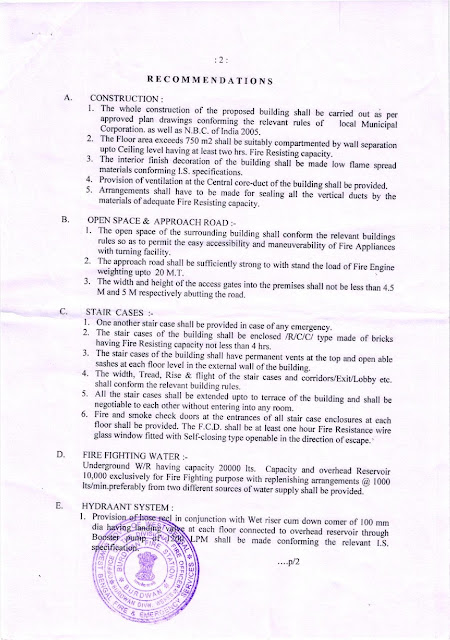


This is just an example ☝☝☝☝


