Benefits of a Voice Alarm System
Voice Alarm System (VAS) / Voice Evacuation systems have become increasingly popular for providing clear
pre-recorded emergency messages. Installed with the safety of staff and general
public as a key function, our systems assist in the effective evacuation of an
area or building during a fire, bomb alert or other emergency. At all other
times a voice alarm system may be used for full-cover or zoned public address
announcements, broadcast advertisements or background music.
Traditional
bells and sounders only give warning tones, they do not indicate the nature of
the emergency, leaving people uncertain and such signals, if ignored, may
result in fatal consequences. The VAS helps to ensure that even untrained
personnel and the general public are evacuated speedily and efficiently.
Voice Alarm System (VAS) / Voice Evacuation systems can install in all offices, factories, warehouses,
shops, sports arenas, cinemas, theatres, schools and public buildings. Combined
with our expertise in all aspects of Fire and Life Safety and our ability to
provide bespoke integrated systems – including monitoring and intelligent
building systems – we ensure all messages are broadcast clearly and all
emergency procedures and systems operate efficiently and effectively to ensure
safety.
Controlled evacuation
In high
rise buildings with large occupancies, a combination of clear pre-recorded
messages and live announcements broadcasted to selected zones enable a
controlled and gradual process of evacuation (referred to as phased
evacuation). Phased evacuation methods enable selected areas to be evacuated in
turn; typically those in most danger will be evacuated first, while surrounding
zones are put on alert. The VAS works automatically, with all controls easily
overridden by fire officers or building control when needed.
In many
buildings it is not possible to use a lift in the event of a fire; lifts are
often made to travel to the ground floor the instant the fire alarm system is
activated. This leaves the stairwells and other evacuation routes available for
people to follow in order to escape the building. In a high rise, or any
multi-level building, simply expecting everyone to leave the building at the
same time could, potentially, lead to panic and blockage on these evacuation
routes. The ability to initiate a controlled, area-by-area evacuation of a
building – phased evacuation – helps prevent this.
Staged
evacuation is the process where staff or occupants may be alerted to a
situation that is being investigated, while the responsible staff ascertain the
danger before evacuating the building or cancelling the event. Such a process
is best supported using a clear, pervasive and quick method of communication.
It may be incredibly difficult to cancel an evacuation in progress without
clearly understood instructions and organisations may experience significant
business continuity losses in the event of false alarms.
Some
manufacturers of professional voice alarm systems and electro-acoustic
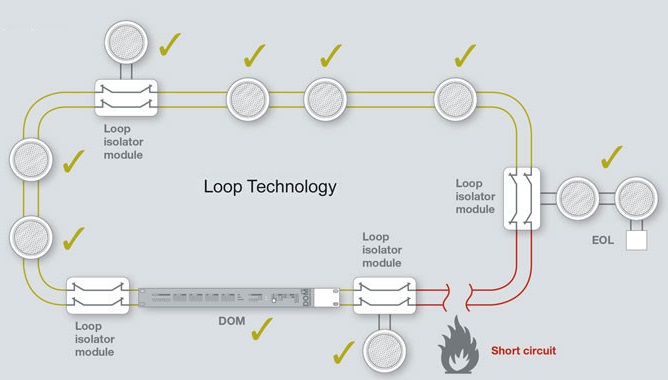
emergency warning systems are currently working on loop technology for 100 V
loudspeaker connections. Usually, loudspeakers are still connected to the voice
alarm system through spur technology. If a spur circuit is interrupted,
however, all loudspeakers after the wire breakage would fail. During a short
circuit, the entire spur circuit fails. In order to minimize risk in the case
of wire breakage and short circuit, A/B cabling is used for systems based on
DIN VDE 0833-4 (security levels 2 and 3), with half of the loudspeakers in a
room operating on different loudspeaker lines. Thus, in a wire-to-wire short
circuit (wire breakage, short circuit or ground fault), half of the loudspeakers
in the relevant area remain in operation. So if the alarms sound at half power,
the sound level is reduced by 3 dB, as long as the loudspeakers are correctly
arranged. This level decrease is permitted in accordance with DIN VDE 0833-4
standards. In contrast to fire detection technology, loop wiring technology
itself has not yet been established as the standard in the area of voice alarm
systems (VAS), because considerably higher power must be transmitted there.
International evacuation standards
The
following is an extract from SANS10139. If you are doing phased or staged
evacuation on the fire system, then the voice evacuation system will follow the
same principles
“There
are various circumstances in which a staged fire alarm arrangement may be
appropriate. These include, but are not restricted to, the following:
a) In
certain large or high-rise buildings, it might be desirable to evacuate first
those areas closest to the fire and immediately above it; other areas are
evacuated thereafter. A particular example of this arrangement, commonly used
in high rise buildings, is known as phased evacuation; in this case,
conventionally, the floor of fire origin, the floor immediately above (and,
often, any below ground areas) are evacuated as a first phase. Thereafter, each
subsequent phase involves evacuation of two floors at a time, until all floors
are evacuated in a number of such phases. This arrangement enables the number
and/or widths of stairways to be reduced; under these circumstances, it is
important that no control is provided to evacuate the entire building in a
single phase, as there will be insufficient stairway capacity for simultaneous
evacuation of all occupants.
b)
Phased evacuation is also sometimes used in other types of building,
irrespective of whether there are reduced stairway capacities (e.g. leisure
complexes, shopping centres and transportation terminals). In these cases, the
initial phase of evacuation may be horizontal, into a place of relative safety
within the building.
c) In
hospitals, a system of ‘progressive horizontal evacuation’ is used, in which
patients closest to a fire are moved horizontally to an adjacent fire
compartment. In a large hospital, further evacuation might, again, involve only
horizontal movement, without the need for more difficult vertical evacuation.”
Despite
all of the evidence reporting the greatly increased response times and improved
evacuation, installations of VAS are still relatively low. For general
applications in larger projects such as arenas, shopping malls and high-rise
buildings, VAS installations are steadily increasing; for smaller buildings it
is still fairly uncommon.
A VAS
has to work when needed (especially and specifically during an emergency) and
is, therefore, fully monitored at all times. Furthermore, the system is backed
up by batteries which are fully charged and checked constantly; this will
ensure that during a mains power failure, the system will continue to operate.
Each voice alarm system is designed and built specifically for each project;
typically, no two systems are identical.
A
standard system built using today’s state-of-the-art technology in accordance
with DIN VDE 0833-4 or EN 60849, an A/B or simple cabling in spur technology is
sufficient, depending on the application. Though loop technology requires
additional isolator modules, they initially create additional costs. However,
at second glance the entire system can be significantly less expensive, with
cost savings in other places. So, depending on the application, cost-intensive
E30 cabling can be partially avoided.
In
regard to building ordinances, DIN VDE 0833-4 is not specified for required
voice alarm systems in section 7.10.3. This may be waived for loop wiring
systems of otherwise functional integrity, if it is guaranteed that forward and
return lines are routed in separate cables, and that these cables are laid out
separately in buildings with fire protection technology. In addition, it must
be ensured that the intended function of the VAS is not affected by a single
failure in these loop wiring systems. That might be the case in the technology
described here.
It is a
sad state of affairs that our current building regulations in South Africa do
not specifically request the requirement for voice evacuation systems, leaving
the door open to omit these systems as a cost saving exercise, overlooking the
safety benefit of these systems and putting the lives of people who occupy the
buildings in jeopardy.
Benefits of a VAS
• Clear,
spoken instructions to people during an emergency event.
•
Selectable pre-recorded messages.
•
Microphone priority handling.
• Full
control during the evacuation of a building/phased evacuation: area-by-area,
floor-by-floor, multiple areas/ floors all at once – whichever is most
appropriate for the situation and layout of the building.
•
Supports dynamic issuing of instructions and routing of persons away from
danger through clear communication.
•
Battery-backed: the system will continue to operate even in the event of a
mains power failure.
•
Ability to cancel false alarms and announce all clear messages.
•
Ambient noise sensing: broadcasts will still be heard regardless if the
background noise levels increase (the VA system can automatically adjust the
volume of the broadcast).
•
Day-to-day advantages: public information announcements, background music (gain
revenue via advertisement injection and more).